

You’re a UK pilot picking up freelance flying. Instructing, simulator work, or contract assignments on the side. The choice between a sole trade and a limited company affects your tax, your admin, and how the money actually reaches your pocket.
It gets more complicated once that income sits next to a PAYE airline salary. Or international flying. Or serious training costs. This is exactly why accountants for pilots tend to look past turnover alone. They look at the whole working picture, not just one number on an invoice.
There’s no universal best structure here. Employment status comes before any of this. IR35 might matter too. Pilot-specific expenses can shift the calculation more than people expect, and PAYE plus freelance income adds another layer on top.
Are You Actually Self-Employed?
Having a contract doesn’t always make you self-employed. HMRC looks at the real working arrangement, not the label on the paperwork.
Who controls when and how you work? Can you take assignments from other organisations? Could you send a substitute in your place? Who carries the financial risk if something goes wrong?
A pilot flying almost exclusively for one airline looks very different from one picking up instructor work across three flight schools. The contract wording matters less than what actually happens day to day.
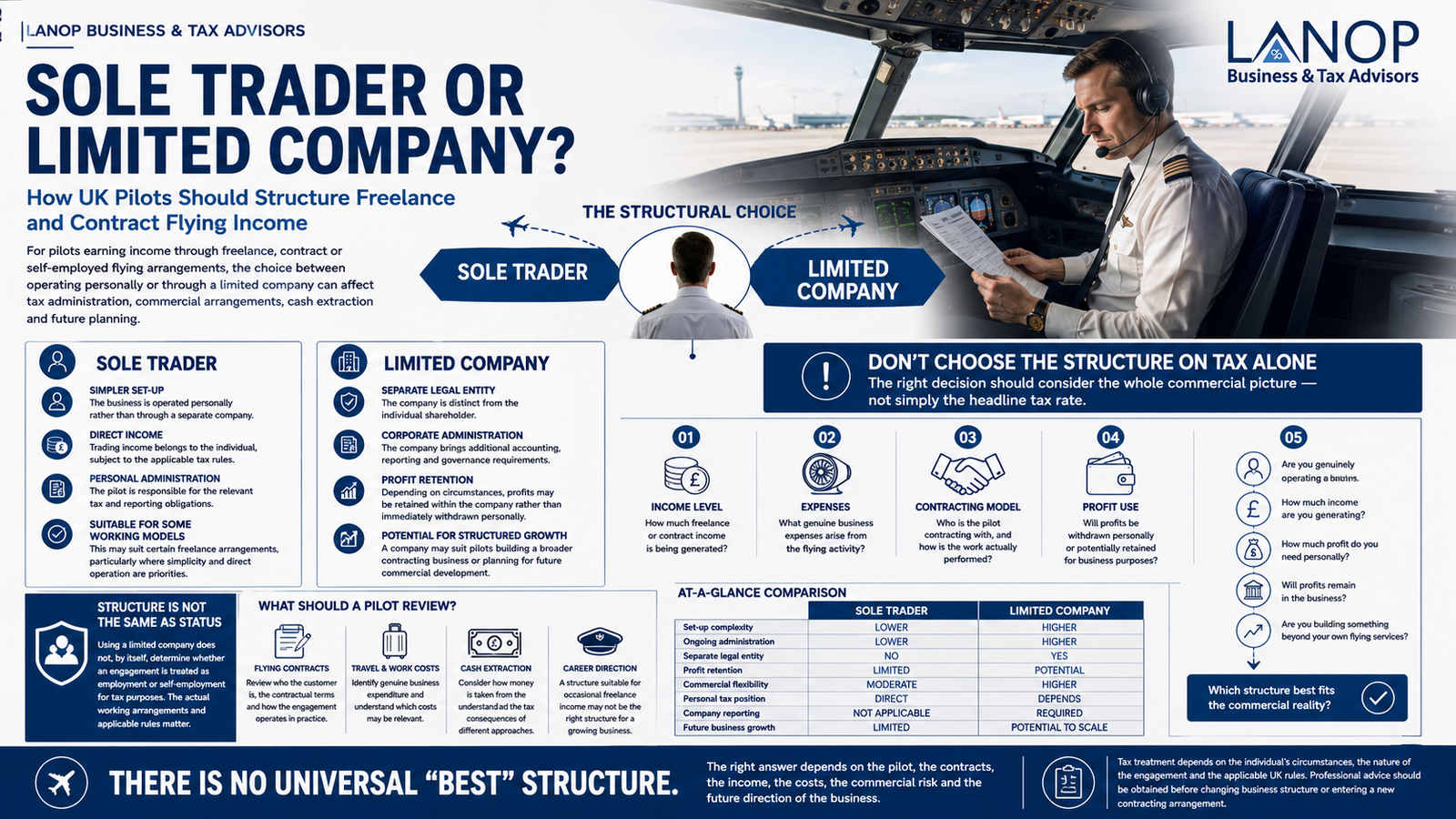
Sole Trader vs Limited Company
A sole trader setup is simple. Profits get taxed through Self Assessment. There’s less admin, and liability sits with you personally.
A limited company is different. It’s a separate legal entity. It receives the income, files its own accounts, and the money stays company money until you extract it properly. More admin. Potentially more tax planning room. Limited liability that isn’t quite as bulletproof as people assume.
| Factor | Sole Trader | Limited Company |
| Setup | Simpler | More formal |
| admin | Lower | Higher |
| Personal liability | Generally personal | Company is separate, with exceptions |
| Taking profits | Direct | Requires proper extraction |
| Retained profits | Not separate from personal finances | Can stay in the company |
| IR35 | Different rules apply | May be relevant |
There’s no magic income threshold where you should suddenly go limited. It depends on your profit. Your existing PAYE income. How much you need personally. Your IR35 exposure. How many clients you actually have.
PAYE Salary Plus Freelance Income
Plenty of pilots hold down an airline PAYE job. They pick up self-employed flying on the side too. That’s fine, as long as the freelance work is really separate and self-employed in nature.
Freelance income sits on top of your PAYE earnings for tax purposes. That can push part of it into a higher rate band without you realising. Keep separate records. PAYE income, freelance income, and any company income if you’ve incorporated, each in its own place.
Pension contributions can work differently depending on the structure too. Worth checking rather than assuming.
Does IR35 Apply to Contract Pilots?
IR35 exists to catch one specific situation. Someone works through a limited company, but the actual relationship looks like employment.
The contract might say “independent contractor.” The reality might show something else. Fixed schedules. Heavy control from the airline. One client taking up nearly all your time. That combination is worth a proper look.
Working for one airline doesn’t always mean IR35 applies. Working for several clients doesn’t always mean it doesn’t, either. Both are relevant evidence. Neither is an automatic answer.
How Is Freelance Pilot Income Actually Taxed?
As a sole trader, business profit gets taxed through Income Tax and National Insurance, through Self Assessment.
Through a limited company, the company pays Corporation Tax on its profit first. You then take money out as salary, dividends, or leave it inside the business. Revenue isn’t the same as profit. Costs come off first. Nobody pays tax on the full invoice amount.
What Expenses Can Pilots Actually Claim?
Licence costs. Medicals. Professional subscriptions. Exams. Training. These can potentially count, depending on the specific situation. Headsets, charts, and navigation kit sit in a similar category.
Work-related travel and certain accommodation can qualify too. Ordinary clothing generally doesn’t. Genuine work-specific uniforms are treated differently, though.
The real test isn’t “did I use this for work.” It’s whether it meets HMRC’s actual rules for that expense category. That’s exactly where a lot of pilots trip up.
Training, Type Ratings and Simulator Costs
This is where the money gets serious. And the rules get more nuanced than most pilots expect.
Training that updates skills within an existing business tends to sit differently to training that launches an entirely new career. Type ratings and recurrent simulator sessions depend heavily on the specific purpose. There’s no blanket yes or no here.
If an airline funds or reimburses training, that changes the picture again. Keep every invoice, contract, and payment record. That paper trail is what actually settles these questions later.
How Should a Pilot Take Money From a Limited Company?
A client paying the company £60,000 is not the same as a pilot personally earning £60,000. That money belongs to the company. It stays there until you take it out, through salary, dividends, or left inside.
Taking money out needs planning. Look at your PAYE income, dividend tax, Corporation Tax, and pension together. Don’t just pick a salary or dividends on its own.
International Flying and UK Tax
Flying for an overseas airline doesn’t always remove you from UK tax. Residence status depends on the actual facts of your situation. So does any relevant tax treaty.
Spending lots of time overseas doesn’t always make someone non-UK resident either. This is one area where a generic online guide can really cost you money.
Common Mistakes Worth Avoiding
Assuming “contractor” always means self-employed. Going limited purely because someone said it saves tax. Ignoring IR35 entirely. Treating every expense as always deductible. Mixing company and personal money. Ignoring VAT until turnover’s already high. Assuming international flying means no UK tax at all.
Frequently Asked Questions
Can a pilot be both PAYE and self-employed at the same time?
Yes, plenty of pilots hold an airline PAYE job alongside really self-employed freelance flying work. The key is that freelance work needs to be really separate and independent in nature. Keeping clear, separate records for each income stream makes tax time a lot simpler.
Is it better for a pilot to be a sole trader or limited company?
There’s no universal answer, since it depends on profit, existing income, and how the work is structured. Occasional side income often suits sole trader simplicity better than the extra admin of a company. Regular, higher-value contracting is where a limited company more often becomes worth exploring.
Does IR35 apply to contract pilots?
It can, especially where a pilot works through a limited company for what looks like one main client. The contract label matters less than the actual working relationship and level of control involved. Multiple clients and genuine independence both count as relevant evidence, though neither guarantees an outcome.
Can pilots claim training and type rating costs against tax?
It depends on the specific situation, not a blanket rule that applies to every type of training. Training that develops existing skills is treated differently to training for an entirely new career path. Keeping detailed records and evidence of business purpose matters more than people usually expect.
How much should a pilot earn before going limited?
There isn’t a single income threshold that makes the decision for you always. It comes down to profit levels, existing PAYE income, IR35 exposure, and administrative costs together. Comparing potential tax differences against the actual cost of running a company is the real calculation.
Choose the Structure Around Your Flying, Not a Tax Myth
There’s no universal best structure for UK pilots. It comes down to how the work is actually performed. Existing PAYE income. Expenses. IR35 exposure. International activity. All considered together.
This is where Lanop Business & Tax Advisors comes in. Lanop works with pilots directly, not generic contractors. That means reviewing employment status and IR35 exposure before recommending a structure, and planning extraction around your existing PAYE income.
For pilots juggling employment, freelance contracts, and training costs, working with specialist accountants for pilots like Lanop means those moving parts get looked at as one decision.